Thursday, March 12, 2015
Changes to minimum password length for Google Apps accounts
This new policy aligns Google Apps accounts with consumer accounts that already require passwords to be at least 8 characters long.
Existing users can keep their current password even if it doesn’t match the new security requirements, but they will be required to comply when changing their password for the first time. Administrators will also need to comply when resetting passwords for users.
With this change, passwords set via the Google Apps Control Panel from March 14 will need to be at least 8 characters long. Calls to the Provisioning API that try to set a users password that is shorter than 8 characters will also fail with an InvalidPassword error message. For more information on how to programmatically manage user accounts, please check the Provisioning API Developer’s Guide.
Want to weigh in on this topic? Discuss on Buzz

Wednesday, March 11, 2015
Announcing Election Info Using Apps Script to Provide Voting Information
It’s time for the 2012 General Election in the United States and along with it comes the tedious process of finding your voter registration, polling sites, times, directions, etc. The previously announced Google Civic Information API provides a great service to programmatically obtain much of this information based on the your home address. Google Apps Script makes it really quick and easy to build a web application that queries this information and uses various Google services to organize and track your information.
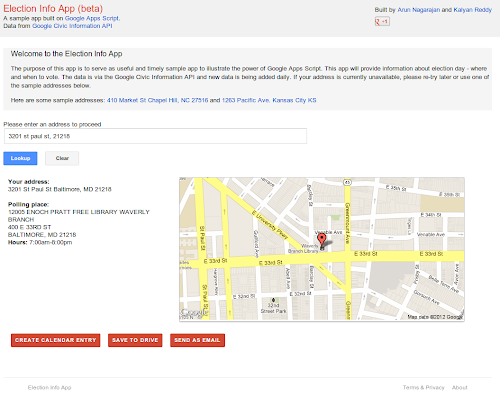
Election Info is a sample application built using Apps Script that can:
- Query the Google Civic Information API to find polling locations and hours using client side JavaScript and AJAX.
- Display polling information using
HtmlServicewith jQuery for a clean effective UI. - Generate static maps via
UrlFetchand theMapsServiceto show polling maps and directions. - Create a calendar event for election day with your polling location using the Calendar service.
- Generate a bring-along document with poll directions and hours using the Document service.
- Send you an email with a summary with your polling place information using the Gmail service.
- Store your previous searches in
UserPropertiesso it will remember your likely home address the next time you launch the app.
As you can see, this is a comprehensive sample app that is useful while also highlighting key Apps Script capabilities.
Install the app from the Chrome Web Store. Check back soon as we will be writing a blog post with details and sample code on how the sample was built.
 | Arun Nagarajan profile | twitter Arun is a Developer Advocate on Google Apps Script. Arun works closely with the community of partners, customers and developers to help them build compelling applications on top of Google Apps using Apps Script. In the past, he spent over 9 years building and designing platforms and infrastructure for enterprise mobile applications.. Arun is originally from the Boston area and enjoys basketball and snowboarding. |
Monday, March 2, 2015
The Best Quick Reference Guides to Web 2 0 on the Planet Period!

THE STORY!
QUICK REFERENCE GUIDES
- JiT2U - Mobile Version to Learning Web 2.0
- Web 2.0 Presentation Tools: A Quick Guide
- Web 2.0 Content Creation Tools
- Web 2.0 Research Tools
- Web 2.0 Survey & Polling Tools
- Web 2.0 Sharing Tools
- Web 2.0 Collaboration Tools
- Web 2.0 Social Networking Tools
- Web 2.0 Tools in Education
- Web 2.0 e-Publishing Tools
- Web 2.0 Annotation & Bookmarking Tools
- Web 2.0 Mindmapping & Brainstorming Tools
- 40 Must-know Web 2.0 Edutools
- Web 2.0 Interactive Tools: A Quick Guide
- More...
RESULTS?
Sunday, March 1, 2015
How to Copy HTML Embed Code to Your Blog!

Heres the poll:

Itll be interesting to see which wins the poll next week. In the meantime, here is a short and sweet tutorial that shows how to copy that embed code to your blog post!


One Secret Recipe to Great Memory is
 Trying hard to forget it!
- Zaid Ali Alsagoff
FORGET IT!
Have you noticed that when you try hard to forget something that you dont want to remember (e.g. a crappy presentation you did!), it becomes harder to forget it. It just sticks in your mind like glue....Forget! Forget! Forget! It isnt going to happen! Memorable incidents whether bad or good will stick longer (or are easier to retrieve from the memory archive).MALE BRAIN VS FEMALE BRAIN
Have you wondered why it is nearly impossible to win an argument with your wife (sister/girlfriend/mother/any women for that sake), especially if its about personal, emotional, or social incidents. You will have one big point (It wasnt me!), and then she will have a few hundred small points that you cant challenge or remember. It will be like...but, but, but, but, but... Oh man, I wish I had such great memory for details. That would make my life easier (or worse)!Dont believe me, watch this:
MY 32 CENTS!
Have you wondered why subjects you enjoy to study are easier to learn and remember? What happens in your mind when you enjoy something? You keep on thinking about it! If you dont enjoy it? You think about something else!The secret? One word: REPETITION
Things you like, you repeatedly think about in your mind.
To improve your memory you could eat healthy, exercise well, play brain games, use millions of memory techniques, and all the other who-ha prescribed by the memory gurus. I have tried them all without too much lasting success.
But I do know that when I try really hard to forget something, it usually sticks better than any other method that I have ever tried. I suppose in the process of trying hard to forget I am evoking an emotional state (e.g. angry), and by doing it repeatedly it makes it nearly impossible to forget.
In a never forgetting memory shell, make whatever you want to remember memorable by trying hard to forget it in an emotional state repeatedly.
Now, forget what you have just read! FORGET! FORGET! FORGET! FORGET!
If you cant remember, you havent tried hard enough to forget! GET IT?
Who cares if you can remember (digital databases do a better job!), if you cant understand, apply or create some form of value from it! That makes more sense... Now I get it!
What about you? What is your secret recipe to great memory (with understanding!)?
How to Embed a Video in Smart Notebook!

Heres the poll for anyone interested!


Dont you just love when theyre short and sweet?
I do plan on adding some other Smart Notebook Tutorials in the future, but in the meantime I want to add a Microsoft Word/PowerPoint option... how to make any font into an outline!

Saturday, February 28, 2015
10 Top ETL Blogs You Simply Don’t Want to Miss!
- Top Eight E-learning Blogs (Jeff Cobb)
- 8 Top Elearning Blogs You Don’t Want to Miss
- The 19 Best Elearning Blogs
 WHAT?
WHAT?
As we are approaching closer to 2008, we will increasingly see all sorts of Top 8, Top 10, Top 20, Top 100, etc. lists, ranking everything from underwear to blogs. Should we take these kind of rankings seriously? No idea! It really depends (on the criteria and whos involved!), but surely if the ranking is done by someone or a group (Wisdom of the crowds!) that is influential, recognized, an expert, popular, respected, and/or widely read, it will have some impact on what we are doing (increased online traffic, global awareness, ego boosting, increased effort, etc.). Whatever it is, we somehow often get an extra kick out of reading this TOP something stuff. Better yet, if we are ourselves mentioned (or top of the pops!), life suddenly shines a bit brighter for a while (Jeff Cobb, thanks for mentioning my blog!). It feels great, Hip-Hip-Hurray! Yippy Kay Yaw Yeah!
Though, whatever recognition, awards or top rankings we get, hopefully it does not change our attitude to learn. In other words, recognition, awards, and rankings, should only increase our efforts/hunger to learn :)
MY TOP 10 ETL BLOGS?
Although, I am not really known (yet!), or an influentional person in education, I am going to share with you my top 10 (favourite) ETL (Education + Technology = Learning) blogs that takes up my time, as I struggle to learn more about education, learning technologies, and importantly the art of Learning How to Learn more effectively. My ranking uses no particular formula, so please do not get offended if you are not on the list (or lower than expected!). This top 10 list is simply ETL blogs that occupy my interest and time. So, I suppose the time and interest factors play important roles in my ranking. Not sure really! Probably, my humble common sense and gut-feeling plays a prominent role, too. Stop! Here is my top 10 favourite ETL blogs:
- Stephen’s Web - OLDaily
If you are looking for ETL-related news, trends, reflections, etc., Stephen Downess OLDaily is a homerun (Actually a season full of homeruns!). I have yet to find a better ETL blog out there in the blogsphere! Stephens short reflections to all the juice he daily (5 times a week!) extracts from his intelligent surveillance of hundreds of ETL blogs (400+, if I am not mistaken!) are enjoyable, useful, relevant, and contains a lot of wisdom (to my humble knowledge!). Though, since he posts so often, you might sometimes miss the really juicy stuff (unless you have a lot of time!). Also, he posts links (URLs) to all his talks, presentations, and reflections (even from his office or bedroom. Not sure where! Better ask him!) on his blog, which often includes audio and/or video recordings, too. These learning resources enable us to get a deeper understanding of his thinking and ideas about learning and education. In short, we can in a way experience his learning journey (process) on Learning How to Learn more effectively, as he learns. Click here to learn more about Stephen. - EduResources Weblog
Joseph Harts regular posts on mostly Higher education online resource discoveries accompanied by short but valuable reflections, is something you simply dont want to miss, especially if you are an educator. His blog might not be as flashy as some of the other ETL Blogs, but his valuable words and wise reflections are engaging, relevant, and useful to our learning mind. Also, check out his other great blog The Open Learner, which explores the usage of open knowledge resources across a diversity of subjects, levels, and interests for a wide range of learners and learning communities. - elearnspace
George Siemenss elearnspace (Check out the Homepage, too!) is a great ETL blog to keep yourself updated about the latest juice in elearning, knowledge management, networks, technology, community development, and corporate learning. Also, check out his Knowing Knowledge book (Free!), which reflects the future of knowledge and learning. What I really like about this guy, is that he is always up to something innovative and is not scared to fail (e.g. Corporate Learning: Trends and Innovations Free Online Conference). - Janes E-Learning Pick of the Day
If you are looking for the latest e-learning (or learning) tools, Jane Knights blog is simply Toolicious! Also, check out Jane Knights amazing directory of 1800+ learning tools. In addition, I love the fact that she provides us with a weekly round-up of the new learning tools added to the tools directory. Her blog posts are concise, attractive, and juicy. Hmm, got a lot to learn here!!!! - Learning Trends
Elliott Masies Learning Trends blog is my favourite corporate learning blog. He himself is a dynamic, creative and innovative guy always looking for new ways to connect, contextualize, and innovate the learning process, so I would not want to miss his reflections. If you arent already subscribing to his Learning Trends, perhaps it is time! - The Rapid eLearning Blog
When you think about improving your rapid e-Learning, instructional design, PowerPoint or graphic creation skills, Tom Kuhlmanns Rapid eLearning blog provides you with a lot of great advice, tips, examples and short-cuts (One word = Amazing!). Also, dont forget to get his free elearning ebook while you’re there. In short, this blog is my favourite Rapid e-Learning learning blog! - Clive on Learning
If you are looking for reflections from an experienced expert on instructional design and insights on educational trends, I believe Clive Shepherds excellent blog will nourish you well. He is also the man behind the 30-minute and 60-minute Masters in Instructional Design (or rapid e-learning design). Also, check out Clives 33 Columns! Although, he does not post as often as some of the other super ETL bloggers, his reflections and insights into education, instructional desigin, online learning, etc. is worth the wait. - Open Culture
Open Culture led by Dan Colman, is a super blog exploring cultural and educational media (podcasts, videos, online courses, etc.) that’s freely available on the web, and that makes learning dynamic, productive, and fun. In addition, you should explore Open Cultures excellent podcast library, too. - Helge Scherlunds eLearning News Blog
If you are looking for an excellent ETL news blog, Helge Scherlunds blog is a really active one discovering a lot of wonderful learning juice. Coming to think of it, this blog is nearly as active as Stephen Downess OLDaily in updating readers about ETL stuff going on around the world (especially in Europe and Denmark!). The only reason, I have not ranked this blog higher, is because it does not seem to do much more than sharing great discoveries in an attractive and engaging way. I suppose, when I can learn more from Helge Scherlunds own learning reflections and thoughts, I will spend even more time engaging in this excellent and useful ETL news blog. - Online Learning Update
Ray Schroeders Online learning blog is a great learning place to discover e-learning articles and news around the world (Europe, Middle-East, Asia, Australia, US, Canada, Africa, etc.). Also, check out his Educational Technology blog, too. Actually, I would have ranked Ray Schroeders blogs higher if he had included more of his own reflections embedded with all these wonderful ETL discoveries. But, if you are simply looking for up-to-date news about e-learning and learning technologies, this is an amazing treasure with hundreds of posts.
 In addition to these 10 great ETL blogs, the rest of the ETL bloggers that I have identified (or links) on my Gurus list (right-side of my blog) do occupy my learning time, including Jay Cross, Patricia Donaghy, Jeff Cobb, Gabe Anderson, Wesley Fryer, Tony Karrer, and Robin Good. However, it would also be nice to add at least one Malaysian or Singaporean ETL blogger (that writes in English!) to my learning time, but at the moment I am still searching for one that really excites my learning mind. Got any suggestions? I apologize for my learning ignorance.
Wherever we go now or in the future, one thing will probably remain the same - Sharing Knowledge and Ideas is Power (Collective Wisdom!). If we dont practice this within our own community, group, or even to ourself, we will certainly have problems adapting to todays fast evolving global economy driven increasingly by Creativity and Innovation through collective wisdom :)
Friday, February 27, 2015
How to Print Anything at a Smaller Size!
So... time to show you how to print anything at a smaller size!

Before I go into the poll and the tutorial, do you see the ADORABLE product in my preview? Well... its fabulous and its free from The Primary Gal! Shes relatively new to blogging and TPT so head over there and give her some love!

Now, for the poll! This was clearly the winner but the other options were definitely contenders!

And of course, heres the tutorial! Step 1 mentions that its easiest to do this with a PDF, so if youre not sure how to make a PDF, be sure to check out my previous tutorial below!

The steps are slightly different on Mac and PC so I did two separate write ups!


As for next weeks poll, Im going to add how to make a customized search so that it only searches specific websites... this is perfect for research projects!
Keyboard Shortcut to Alight Your Text on the Right!
This one is also for Microsoft Word and PowerPoint, though you should definitely try it in other programs as well... it just might work!

Try it out and let me know how you like it!
Thursday, February 26, 2015
How to Make a Bunting Banner in PowerPoint!

More than half of you voted for this in the polls!

Now, onto the tutorial!


I am printing that bunting banner first thing tomorrow morning! I love how it looks!!!
For next weeks poll, Ill add how to use/open QR codes. I figured this would be a good prerequisite for how to make your own QR codes!
Use Google Translator To Translate OER Into 47 Languages!
- Google Translator Toolkit
- Demo Video
- Via Joseph Hart

"...Of course translation services are vital components to facilitate the world-wide sharing of educational resources. " - Joseph Hart
WHAT?
"Google Translator Toolkit is part of Googles effort to make information universally accessible through translation. Google Translator Toolkit helps translators translate better and more quickly through one shared, innovative translation technology.
Heres what you can do with Google Translator Toolkit:
- Upload Word documents, OpenOffice, RTF, HTML, text, Wikipedia articles and knols.
- Use previous human translations and machine translation to pretranslate your uploaded documents.
- Use our simple WYSIWYG editor to improve the pretranslation.
- Invite others (by email) to edit or view your translations.
- Edit documents online with whomever you choose.
- Download documents to your desktop in their native formats --- Word, OpenOffice, RTF or HTML.
- Publish your Wikipedia and knol translations back to Wikipedia or Knol." - Source
EXAMPLE PLEASE!
"For example, if an Arabic-speaking reader wants to translate a Wikipedia™ article into Arabic, she loads the article into Translator Toolkit, corrects the automatic translation, and clicks publish. By using Translator Toolkits bag of tools — translation search, bilingual dictionaries, and ratings, she translates and publishes the article faster and better into Arabic. The Translator Toolkit is integrated with Wikipedia, making it easy to publish translated articles. Best of all, our automatic translation system "learns" from her corrections, creating a virtuous cycle that can help translate content into 47 languages, or over 98% of the worlds Internet population." - Michael Galvez and Sanjay Bhansali
EASE-TO-USE?
I suppose English to Arabic, Chinese, Korean, Japanese, etc. might not be as accurate as English to Norwegian (or other European languages), but I am sure it is sufficient to understand, and then we could always use the new toolkit to touch up the remaining 2-10% out of context. When I have used Googles Language arsenal to translate my posts into Norwegian, it is if it is reading my mind about what I want to say (except for a few glitches here and there). It is amazing!
I suppose many translators might say these translation tools are not up to mark, but I suppose they are in a way trying hard to protect their profession and pay. But these tools are going to get better and better, and if they arent using such tools to speed up their translation work, or simply arent that good (at translation), they better start looking for a new job and profession. Be smart, use the tools and add your contextualized expertise to perfect the translation (99.97%).
Also, this growing collection of freely available translation tools are going to do wonders in translating Open Educational Resources (OER) to 47 languages (over 98% of the worlds Internet population). Lets use these tools to globalize OER into everyone corner of the world. At least 98% of it!
Translation professionals out there, dont be proud and stubborn, start using Google translator kit (or other better alternatives out there!)! You might argue, it was bad before, but they are getting better, and they might within a few years challenge you word for word to the extreme. Master them now, so when they eventually meet your expectations, you are ready. If you are already using such tools, RESPECT!
Finally, if I had to sum up my opinion on Googles translator toolkit using just one word, it would be:
Awesome!
Hopefully, it translated correctly :)
A Giveaway with a 100 Chance to Win!
Do you want to enter a giveaway where there is a 100% chance that you would win? Then, this post is for you! I just posted a new Uno game in my TPT store: An Alphabet Recognition Uno Game!

This game coordinates with the other Uno games Ive created. By entering this giveaway, you can win the ABC Uno game and ANY OTHER UNO GAME I CREATED!!!
Heres what you have to do to win the Alphabet Uno Game:
1. Follow my blog.
2. Follow my TPT store.
3. Leave me a comment telling me that you did both!
I know that the alphabet game is a bit simple for the older grades, but this second part of the giveaway is perfect for any grade! Heres what you can do to get one of my other Uno Games for free:
1. Blog about this giveaway, linking back to this post.
2. Leave me a comment with the link to your blog post and telling me which Uno game you want me to email you!
You can check out the other Uno games in my TPT store! There are currently games for the Dolch Pre-Primer (Freebie), Primer, 1st Grade, 2nd Grade, and 3rd Grade Words!
Anyone who does either of the above before Saturday, April 14 at noon EST will win!
More than 100 Free Places to Learn Online Jeff Cobb
- Link to More than 100 Free Places to Learn Online
- Jeff Cobbs Juicy Resources

"... There is so much available out there for free—even things that offer credit—and given how easy it is for non-technical subject matter experts to contribute content, it will only keep growing. Quality is all over the place right now, but I suspect competition among aggregators and the growing influence of the open education movement will drive higher quality over time. All of this suggests at least a couple of things, in my opinion:
- If part of your business strategy is to generate revenue from learning experiences provided to members, customers, or students and you haven’t yet considered how “free” impacts you, it’s high time.
- “Free” learning could potentially be one of the better forms of customer engagement in the world of the new Web—though this does not come without issues, as Stephen Downes and Lisa Neal have pointed out in a recent issue of eLearn Magazine... "
FREE LEARNING PLACES?
Major categories:
- Online Tutorials and How-to Sites
- Big Idea and Debate Sites
- Higher Education and Open Education Initiatives
- Free CE, CME, and CEU
- Topical Areas
I love the resources, index style and simple organization (I dont know why, but I simply love straight-to-the-point index style lists)! Of course you might be overwhelmed with such a huge list, but Jeff has done a splendid job in making it easier to actually find relevant and useful learning sites with categories and site tagging (e.g. T – Text-based offerings).
If you ask me to suggest three (3) sites to explore to stimulate new ideas and learn from some of the most creative, innovative and successful (in that respect!) people on this planet, I would refer to Jeffs growing list and link you to:
- BigThink
- FORA.tv
- TED
I got to admit that Jeff Cobbs Mission to Learn blog is increasingly becoming one of my favorite destinations to discover and learn. Last week I discovered his new Learning 2.0 eBook, and now this excellent index of free learning resources. Whats next :)
Wednesday, February 25, 2015
How to Load the Full Version of a Website on your iPad Smartphone!
Unfortunately, theres no magic setting to switch the iPad back to the way it was before the update, but there are lots of ways you can load the full version of a website on your iPad!

Heres the poll for those of you keeping track! And, for those of you who havent been able to vote from your iPad/smartphone, do this tutorial now to load the poll so you can vote for next week! :)

There are three different options that you can use to load the full version of the site... and here they are!


Wednesday, February 18, 2015
Microsoft Investing in Cyanogen Which Wants to Take Android from Google

Microsoft is getting ready for a newer and unexpected battle with Google. This time, Microsoft plans to take on Android by investing in Cyanogen.
Cyanogen is a startup which makes and maintains its own version of Android. Cyanogen is currently being used in the OnePlus One, the flagship killer, a smartphone which has garnered rave reviews last year.
The Wall Street Journal reports that Microsoft is investing $70 million in Cyanogen which is best known for its customized version of Android. Cyanogen has reportedly raised $100 million to date. This should be noted that Cyanogen recently refused an offer from Google and hopes to live its dream of being an open version of Android alive.
WSJ writes:
“Microsoft would be a minority investor in a roughly $70 million round of equity financing that values Cyanogen in the high hundreds of millions.”
What could be Microsoft’s intentions?

This is important and unusual because Microsoft is owner of its very own Windows Phone operating system and is gearing up for the upcoming launch of Windows 10 for mobile devices. This move of Microsoft can be attributed to its commitment to embrace open source and maybe some mischief.
Cyanogen claims to have a team of 9,000 volunteer software developers. Cyanogen’s Chief Executive Kirt McMaster told WSJ last week:
“We’re going to take Android away from Google.”

Buy OnePlus One – The Flagship Killer here: OnePlus One (64GB, Sandstone Black)- Invite Only

Apart from different versions of Android for the smartphone makers, Google also releases the Android core under an open-source license. This version is free for everybody and anyone can use and modify or fork this core without linking the Google services. The best examples are Amazon’s products which run on forked Android. These independent versions are already very popular in China where Google has struggled to leave its mark.
These types of Android versions, which are not under Google’s control, are a problem for Google because not every forked version promotes and uses Google’s services and hence, Google makes no money. Due to this Microsoft’s investment in Cyanogen, it will be harder for Google to bring all version of Android under its control.
Microsoft and Cyanogen, both have declined to comment. By investing in Cyanogen, Microsoft can get more users and claim a bigger share of the mobile market. Under the new CEO Satya Nadella, Microsoft has shown such commitments to open source in the past.
C program to produce the folowing design using s

#include<stdio.h>
#include<conio.h>
void main()
{
int i,j,n;
char ch=A;
clrscr(); //to clear the screen
printf("How many lines?");
scanf("%d",&n);
for(i=0;i<n;++i)
{
for(j=0;j<=i;++j)
printf("%c",ch+j);
printf("
");
}
getch(); //to stop the screen
}
Tuesday, February 17, 2015
C Program and Algorithm for Conversion of an Expression from Infix to Postfix
Algorithm for Conversion of an Expression from Infix to Postfix
- Repeatedly pop from STACK and add to P each operator which has same precedence as or higher precedence than the operator encountered.
- Push the encountered operator onto the STACK.
6. If a right parenthesis is encountered, then
- Repeatedly pop from the STACK and add to P each operator until a left parenthesis is encountered.
- Remove the left parenthesis; do not add it to P.

C Program for Conversion of an Expression from Infix to Postfix
Postfix expression: %s",postfix);
Got Lollipop 10 cool things to try with Android 5 0
 |
| Googles Android 5.0 release is more than just a pretty makeover. Here are 10 fun features youll definitely want to explore once you have Lollipop in front of you |
Theres plenty of new stuff to see, of course -- but once youve finished exploring all the fresh and fancy visuals, here are 10 cool things to try with Lollipop on your Android phone or tablet:
1. Set up a trusted Bluetooth device.
If you have a Moto phone, you may have done this before -- but for the rest of the world, its uncharted terrain: the ability to have your Android device stay unlocked anytime a specific Bluetooth device is present and paired.To set it up, head into your phone or tablets system settings and tap "Security." Make sure you have "Screen lock" set to something other than "Swipe"; youll need to have a pattern, password, or PIN established so your phone can automatically secure itself whenever your trusted Bluetooth device isnt around.
Once youve done that, tap "Smart Lock" on that same menu and then tap "Trusted devices." Tap the red plus sign and follow the prompts to pair your smartwatch, car stereo, portable speaker, or practically anything else -- then sit back and enjoy having easy access to your Android gadget whenever the Bluetooth device is nearby.
(You probably dont have access to it yet, by the way, but youll soon be able to set a trusted place as well. An incoming update to Google Play Services should add that option to all Lollipop devices within the coming days.)
2. Check out the revamped Face Lock feature.
While youre in that same "Security" menu, go back into "Smart Lock" and tap "Trusted face." Follow the prompts to train the system to recognize your face, then press the power button and give it a whirl.
3. Take Lollipops always-listening voice command system out for a spin.
Provided your phone or tablet supports it, you can now give voice commands anytime -- even when your devices display is off.The option to activate the feature is a bit buried: Head into your system settings, tap "Language & input" and then "Voice input," then tap the gear icon next to "Enhanced Google services" and look for a line labeled "Ok Google Detection."
Tap it, then tap the line labeled "Always on" and follow the prompts to train the system to recognize your voice. While youre in that menu, think about whether you want voice commands to work even when your phone is locked with a pattern, PIN, or password; if you do, tap the line labeled "When locked" before you exit out.
Once youre all done, just say "Okay, Google" and your phone will start listening. You can then ask it a question or give it all sorts of commands and have it work for you whether its in your hands or not.
4. Interact with a notification on the lock screen.
Lollipop brings a whole new look to the Android lock screen, and your personal notifications are the main attraction. Next time you press your devices power button and see a notification waiting, try swiping it horizontally in either direction to dismiss it. You can also tap on it twice to open it or swipe downwards on it to expand it and gain access to any quick commands available (like archiving or replying to an email).5. Set up and try priority notification mode.
One of Lollipops more complex but also potentially useful features is the systems new priority notification mode -- essentially a customizable "do not disturb"-style setting for your tablet or phone. Whenever the priority mode is active, only notifications that are considered "high priority" will make a sound and alert you; any other notifications will show up but remain silent.To get started, press your devices volume up or volume down key while the display is on and then tap "Priority" in the panel that appears at the top of the screen. Select either to leave that mode on indefinitely (the default) or to specify a finite amount of time -- an hour, two hours, whatever -- for which itll remain active.

While you have that panel open, take a minute to visit the priority notification settings to make sure its set up the way you want: After pressing a volume key and tapping "Priority," tap the gear icon next to the words "Priority interruptions only." Now think about what types of notifications you want to alert you when you have the priority mode active. You can opt to allow any combination of events and reminders, calls, and messages -- and with the latter two, you can either allow any calls and messages to come through or allow only calls and messages from approved contacts.
6. Schedule a recurring priority notification mode.
Lollipops priority notification mode can automatically activate itself at certain recurring times -- if, say, you want your phone to remain silent except for emergency calls and messages during the night.Go back into that same menu we were just in (you can also get to it by going into the main system settings and tapping "Sound & notification," then "Interruptions"). Scroll down to the bottom of the screen and select what days and times you want the priority mode to activate.
Once youve done that, your device will automatically go into priority notification mode during those windows -- and youll be bothered only by the notifications you absolutely need.
7. Customize how app notifications behave.
Want to take things a step further? Lollipop lets you customize notifications on an app-by-app basis so that any apps alerts can be considered "high priority" all the time.If you set an app to be high priority, youre effectively whitelisting it: Any notifications generated by that app will always alert you, even if your device is in priority-only mode. The apps notifications will also always appear at the top of your notification panel, above any others.

All you have to do is head into your system settings, select "Sound & notifications" and then select "App notifications." Tap any app you want to customize, then toggle the switch for "Priority" to whitelist it.
8. Prepare your phone for guest access.
If you ever pass your phone or tablet off to a friend, Lollipops new guest mode is well worth exploring.To see how it works, open up your devices Quick Settings panel by swiping down from the top of the screen and then swiping down a second time. Tap the circular avatar at the far right corner, then tap "Guest."
When youre ready to switch back to your own account, do that same thing but tap your name instead of "Guest." If you have a security pattern, PIN, or password set, youll be prompted to enter it before proceeding.
9. Pin something to your devices screen.
Weve all been there: Someone you know needs to borrow your phone "for a quick sec" to make a call or look something up online. Or maybe you want to hand your device over to the little one so she can play a game while the grown-ups talk. A new Lollipop feature called Screen Pinning is designed to let you do those types of things without any hassle -- and without having to worry about the person getting into something they shouldnt.Take a moment now to enable it: Go into the main system settings, select "Security," scroll down to "Screen Pinning," and set it to "On."
Then take it for a test run: Tap the Recent Apps key (the square to the right of the Home key) and scroll upward. Youll see a pushpin icon on the most recent app or process youve had open. Tap it and then confirm that you want to pin that process.

To exit the pinned mode, press the Back and Recent Apps (apparently also now known as "Overview") buttons at the same time. If you have a PIN, pattern, or password set -- which you should if you want this feature to have much meaning -- youll need to enter it in order to return the device to its normal state.
10. Beam something to another device.
Android Beam has been around for a while, but its always been hard to know exactly when and how it can work. With Lollipop, Beam is integrated into the system sharing function and is consequently easier to use and more versatile than ever.See for yourself: Open up the Photos app on your device and tap any image you like. Then tap the share icon at the bottom of the screen and select "Android Beam" from the list of choices that appears.
Your phone or tablet will instruct you to bring another Android device against its back. Just make sure the other device is unlocked, then bring them back to back -- and shazam: The photo you selected will transfer wirelessly from one device to the other, even if the other device isnt on Lollipop. No wires, no special apps, no third-party services required.
(Both devices will need to support NFC in order for this to work, but pretty much every reasonable Android device released in the past few years does.)
You can do the same thing anywhere the share command is available -- a social media app, a file manager, you name it. Images, links, contacts, and any other type of shareable content should work.
Bonus: Try your hand at Lollipops hidden Flappy Bird game.
Google loves including fun little Easter eggs in its products, and Lollipop is no exception. Go into your system settings, select "About phone" (or tablet) and then tap the line labeled "Android version" a bunch of times in a row.When you see a large Lollipop graphic appear on your screen, tap the circle part of the image about five times and then press and hold your finger to it. Youll then be taken into an Android-themed Flappy Bird-like game, with lots o lollipop obstacles to jump through and avoid.
Flap, flap, flap. One final tip: If you find yourself playing for more than 10 minutes, put down your device and smack yourself in the head with the nearest rubber mallet. Youll thank me later.